
Amoako Boafo

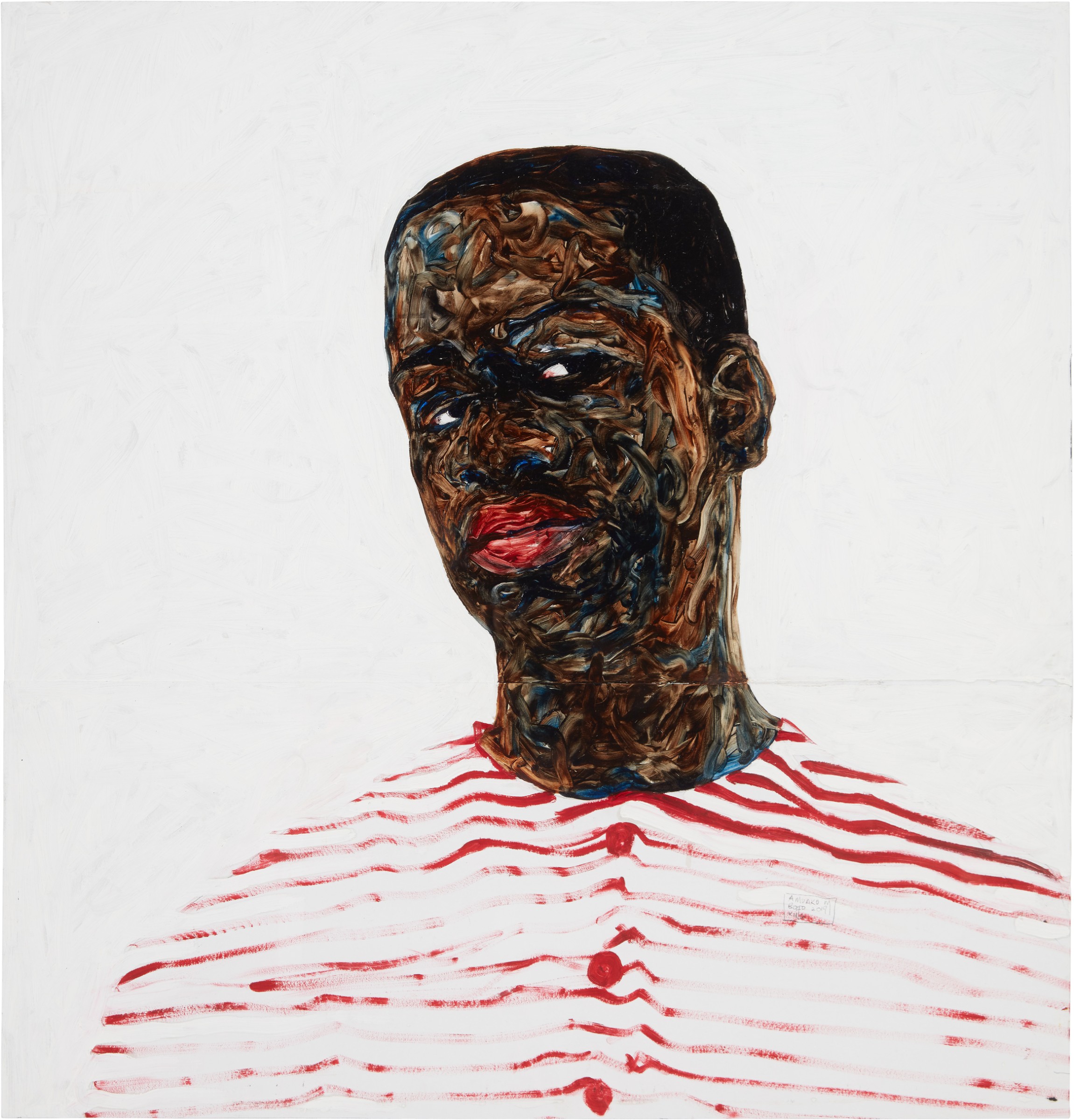
Amoako Boafo (b. 1984, Accra, Ghana) paints the skin of his Black sitters with his bare fingers, working paint directly into the canvas until it registers the same pressure, drag, and irregularity as touch itself, then finishes the surrounding clothing and background with a contrastingly cool, brushed precision that throws the tactile passages into relief.
Boafo trained at the Ghanatta College of Art and Design in Accra, graduating in 2008, before moving to Vienna to attend the Academy of Fine Arts, where the paintings of Egon Schiele and Gustav Klimt sharpened his interest in the expressive possibilities of paint applied directly to skin. He began working with his fingers in 2017, the technique that earned him Austria's Walter Koschatzky Art Award that same year. In 2018, the painter Kehinde Wiley came across Boafo's work on Instagram, acquired several paintings, and introduced him to the Los Angeles gallery Roberts Projects, where Boafo's first U.S. solo exhibition, I See Me, opened in January 2019.
Works
Stories
Essay · Thomas Clifton · July 10, 2024
Amoako Boafo and the Image of the Self
Self-portraits are more than reflections; they are windows into the artist's soul, revealing layers of identity, emotion, and societal influence. They allow artists to explore their inner worlds and express their perceptions of self, bridging the internal and external. This genre of art provides profound insight into the human condition, capturing both the physical appearance and the psychological and emotional states of the artist. Creating a self-portrait can be deeply introspective, where artists confront their own image and the multiplicity of identities they embody. This dynamic interplay of self-perception and societal influence makes self-portraiture a compelling and enduring form of artistic expression.
Read More