
George Condo


George Condo

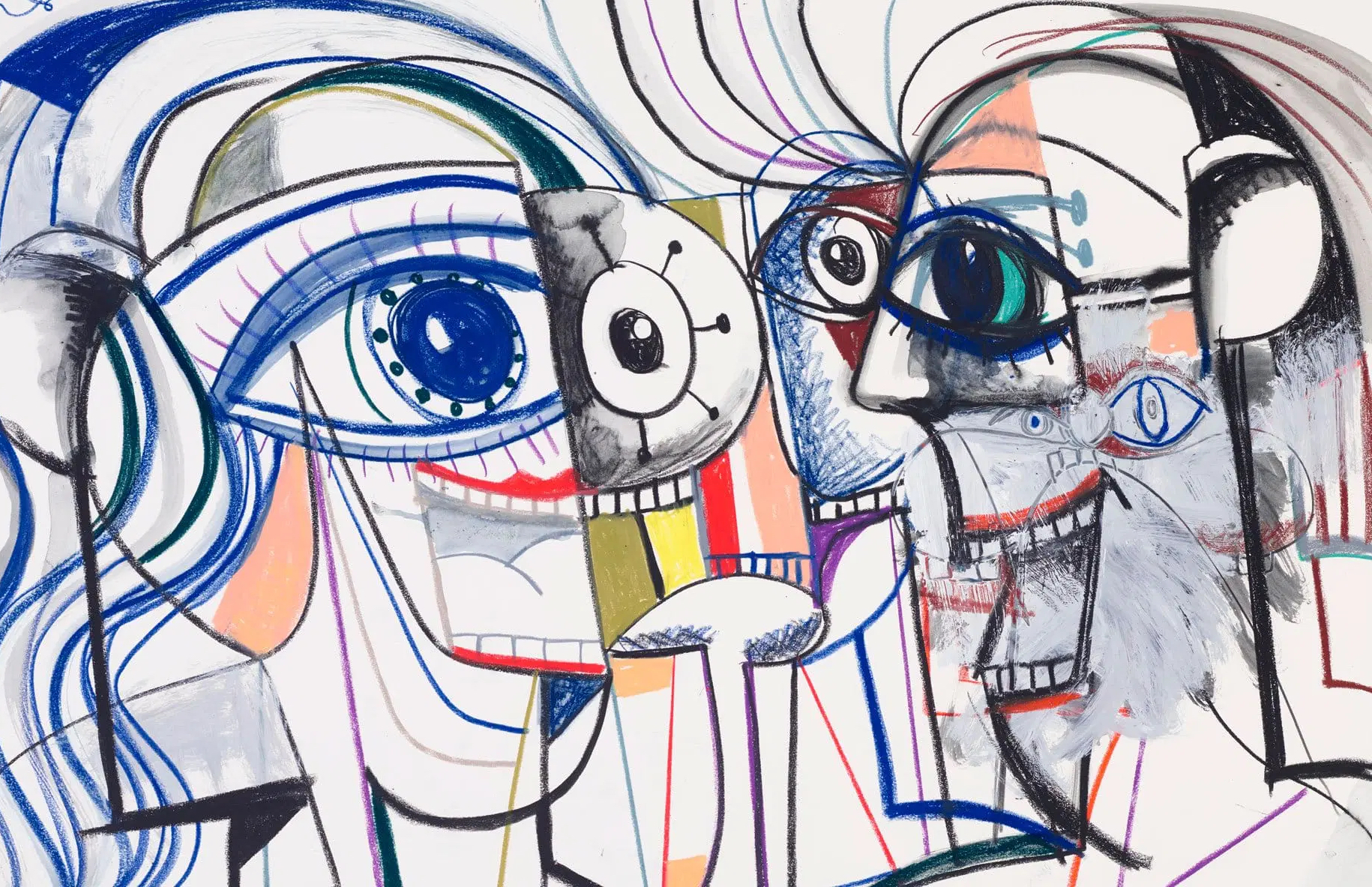
George Condo (b. Concord, New Hampshire, 1957) calls his fractured, multi-expressive portraits "psychological cubism": faces and figures in which several incompatible emotional states, comic and violent, aristocratic and abject, coexist within a single head, as though Cubism's multiple viewpoints had been redirected from physical space to psychological state.
Condo studied art history and music theory at the University of Massachusetts Lowell before moving to Boston and then, in 1979, to New York, where he worked briefly in Andy Warhol's Factory and exhibited throughout the East Village. In 1985 he relocated to Paris for a decade, a period that sharpened the philosophical ambitions of his work: he befriended the philosopher Félix Guattari, who contributed an essay to the catalogue of Condo's 1990 exhibition at Galerie Daniel Templon, and collaborated with the writer William S. Burroughs on paintings, drawings, and etchings, a partnership documented in the Whitney Museum's 1991 publication Ghost of Chance.
An important figure in the revival of figurative painting, Condo returned to New York in the mid-1990s and developed the visual vocabulary that defines his mature work: figures built from disjointed facial planes, exaggerated teeth and eyes, and passages of art-historical quotation, from Old Master modeling to cartoon flatness, compressed into a single, unstable head. His portraiture was the subject of the mid-career survey Mental States, which traveled from the New Museum in New York to museums in Rotterdam, London, and Frankfurt in 2011–12, tracing the development of the style across three decades, and in 2019 his painting Double Elvis appeared in the Arsenale as part of the central international exhibition of the Venice Biennale, May You Live in Interesting Times.
He received the Academy Award of the American Academy of Arts and Letters in 1999, and his work is held in the collections of the Museum of Modern Art, the Metropolitan Museum of Art, Tate, and the Centre Pompidou. Condo's deeper influence lies less in any single follower than in a pictorial permission he helped restore to painting after Conceptual and Minimal art's turn away from the image: that a face could again hold contradiction, humor, and grotesquerie all at once, without resolving into a single legible expression. He lives and works in New York.
