
Richard Serra


Richard Serra

Richard Serra (San Francisco, USA, 1938 – Orient, New York, 2024) redefined sculpture as an experience of space rather than an object placed within it, using steel, lead, and rubber to make gravity and instability physically legible to a viewer's own body.
Serra traced his interest in industrial material to watching a tanker launch at the San Francisco shipyard where his father worked as a pipe fitter, and studied at UC Berkeley and Santa Barbara before completing a BFA and MFA in painting and printmaking at Yale. Settling in New York in 1966, he began treating sculpture as a record of action rather than composition: his 1967–68 Verb List, a handwritten inventory of transitive verbs (to roll, to fold, to splash, to prop), became instructions he tested directly on materials that could register each action's trace. To Lift (1967) raised a sheet of rubber off the floor using nothing but its own tension; Thirty-Five Feet of Lead Rolled Up, made with the composer Philip Glass, then his studio assistant, did exactly what its title says; and in Splashing and Casting, Serra flung molten lead into the seam between wall and floor, then pried the hardened metal free.
By the 1970s these same verbs scaled up into massive Cor-Ten steel plates, propped and tilted and leaned, held upright by little more than balance and their own weight. "Space is my subject," Serra said. "I use steel to organize space." That logic produced his most contested work, Tilted Arc (1981), a 120-foot curved steel wall commissioned by the U.S. General Services Administration as a permanent, site-specific piece for Federal Plaza in Lower Manhattan. After years of complaints from office workers, and a hearing that drew testimony from dozens of artists on Serra's behalf, a federal court ruled the government free to dispose of the work; on March 15, 1989, it was cut into three sections and put into storage, where it remains. Serra had said as much beforehand: "To move Tilted Arc is to destroy Tilted Arc," since a work built for one site cannot be relocated and remain that work, however intact its steel.
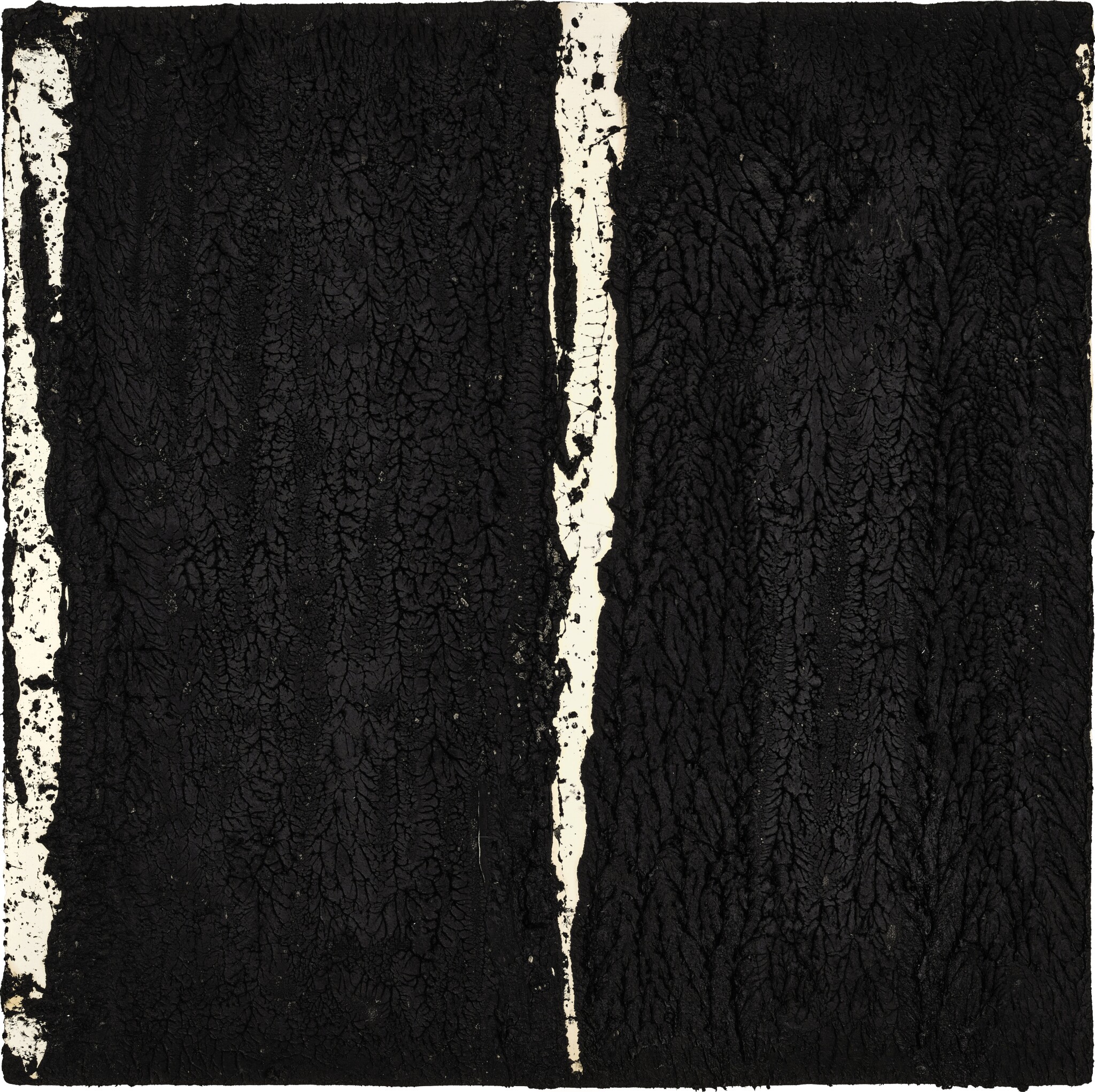
Serra continued to build at increasing scale, culminating in The Matter of Time (2005), spiraling and elliptical steel forms weighing over 1,000 tons at the Guggenheim Museum Bilbao, still governed by the same early verbs of bending and enclosing, now built large enough to walk through. Alongside the sculpture, Serra sustained an equally rigorous works-on-paper practice, building dense fields of black paintstick that pursue the same questions of weight and mass by other means. His work has been the subject of retrospectives at the Museum of Modern Art and the Guggenheim Bilbao, and is held in the collections of the Centre Pompidou, Tate Modern, and Dia:Beacon.
