
Eduardo Chillida
Basque Country, Spain · 1924–2002

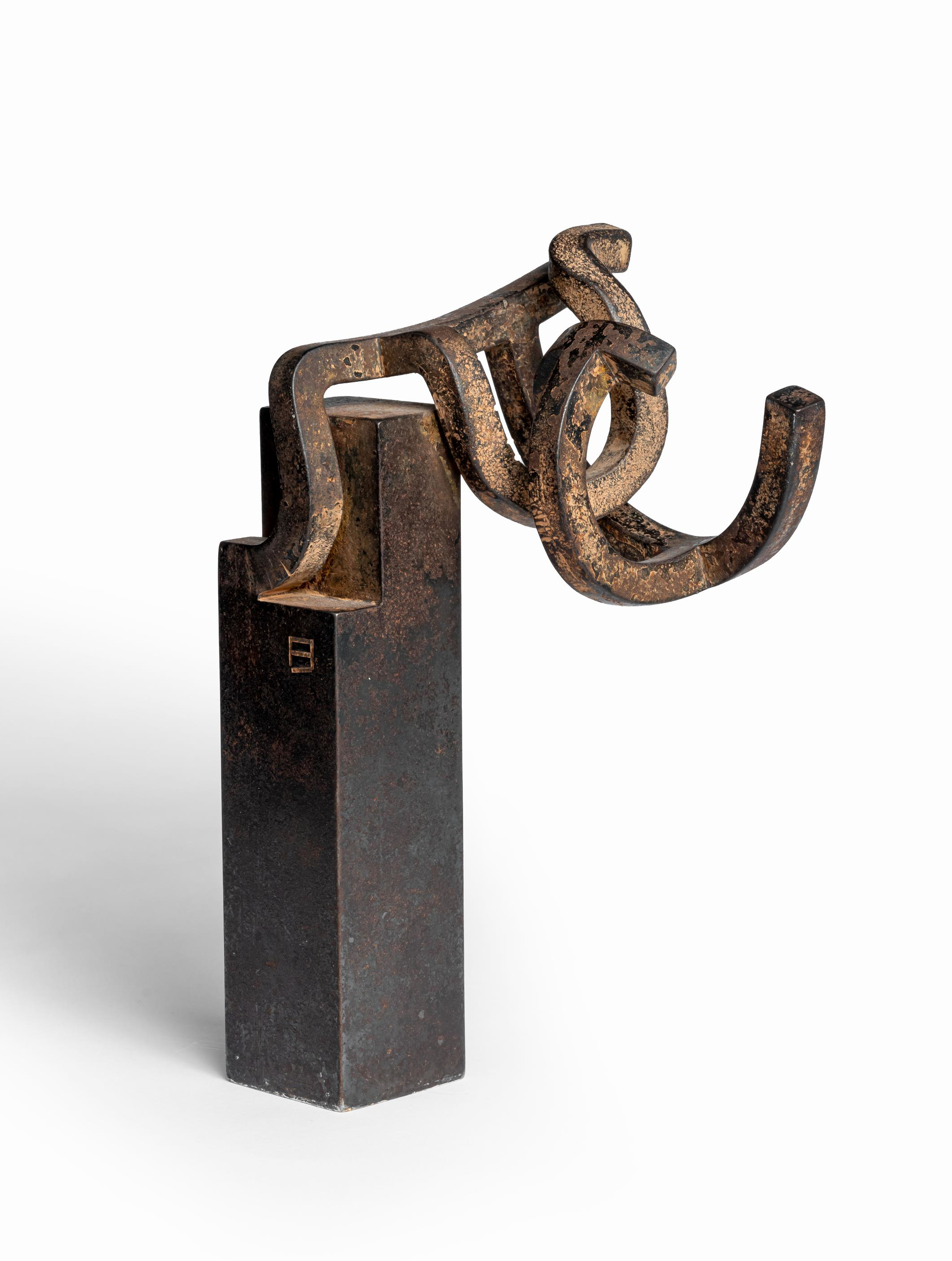
Eduardo Chillida (Donostia-San Sebastián, Spain, 1924 – 2002) was one of the leading Spanish sculptors of the twentieth century, but his true subject was never simply iron or granite: it was space itself. Trained in architecture at the University of Madrid before turning to sculpture in Paris in the late 1940s, he came to see his work as a sustained negotiation between mass and absence, between what a form encloses and what it leaves open. "My work is a rebellion against gravity," he once said.
This preoccupation with space drew Chillida into a real intellectual dialogue with the philosopher Martin Heidegger through the 1960s, culminating in Heidegger's 1969 text Die Kunst und der Raum (Art and Space), which Chillida illustrated with a suite of etchings. That graphic practice, prints, embossed paper, and drawing worked alongside the sculpture rather than after it, letting Chillida test in two dimensions what iron's resistance and alabaster's translucency could not: the cut, the fold, and the opening as marks in their own right, freed from the specific weight of any material.
Works
Argi I, 1988
Etching and aquatint with relief on Segundo Santos paper
8 1/8 x 4 1/2 in (20.5 x 11.5 cm)
Projects
Stories
Essay · ZCA Editorial Team · June 20, 2024
Eduardo Chillida at 100
As the art world commemorates the centenary of Eduardo Chillida's birth, several significant exhibitions across Europe are celebrating his profound impact.
Read MoreSelected Press
ArtdailySeptember 27, 2019
Zeit Contemporary Art presents an online exhibition devoted to the work of Eduardo Chillida
Read Article
InfoenpuntoSeptember 29, 2019
Zeit Contemporary Art, presenta la obra en papel del escultor Eduardo Chillida
Read Article
MeerSeptember 27, 2019
Eduardo Chillida
Read Article
Barnebys MagazineOctober 23, 2019
In Conversation with Contemporary Art Dealer Joan Robledo-Palop
Read Article