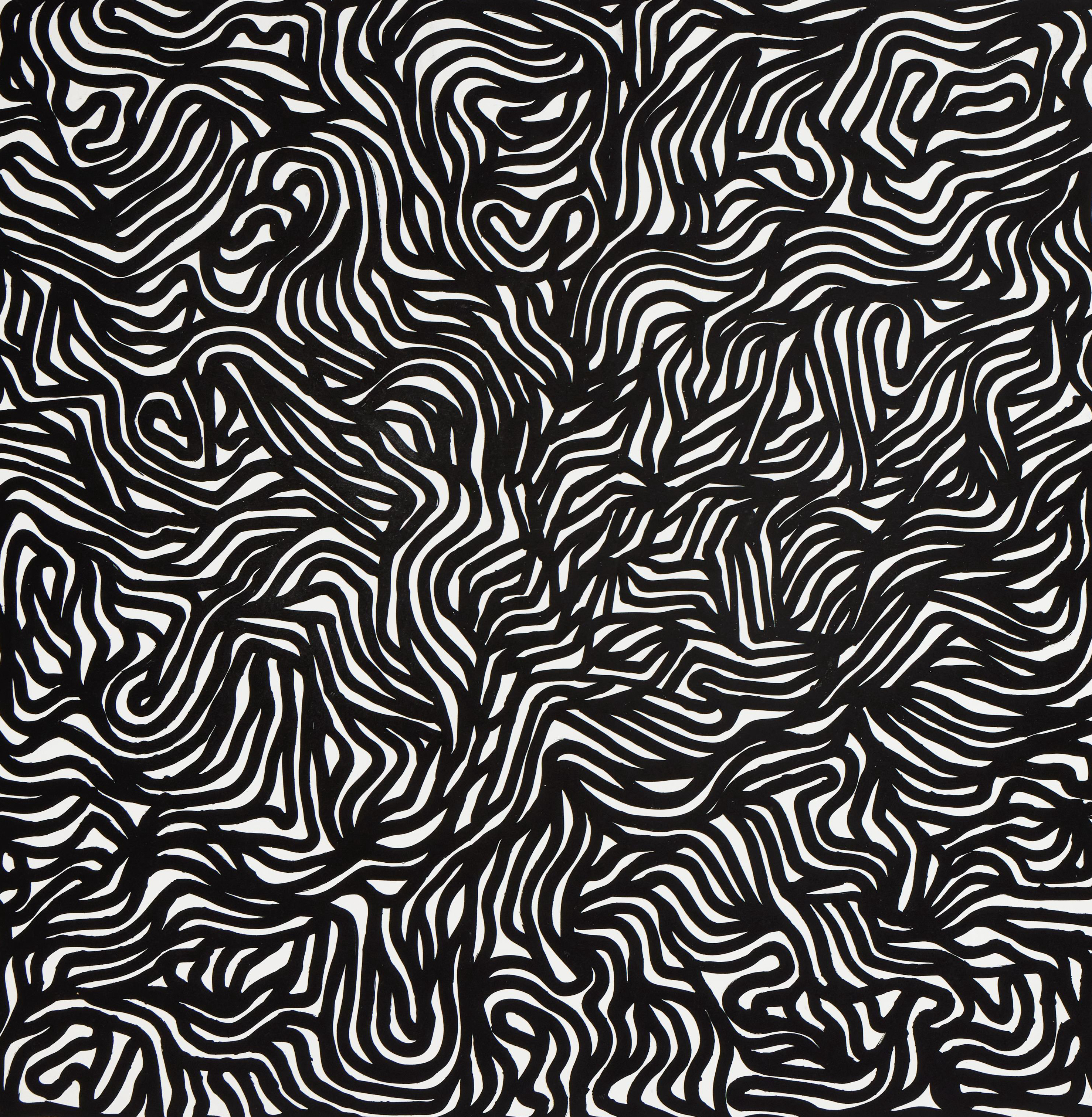
Black Loops & Curves No. 4, 1999
Etching with sugar-lift aquatint on Somerset Textured White
40 x 40 in (101.6 x 101.6 cm)


Sol LeWitt (Hartford, Connecticut, 1928 – New York, New York, 2007) was an American artist recognized as a founder of both Minimal and Conceptual art. His central proposition, that an artwork's instructions matter more than its physical execution, separated authorship from the artist's own hand and reshaped the possibilities of postwar sculpture and drawing.
LeWitt completed his BFA at Syracuse University before serving in the Korean War and settling in New York, where in the early 1960s he worked the night shift as a Museum of Modern Art receptionist, alongside fellow artists Dan Flavin, Robert Mangold, and Robert Ryman, and the future critic Lucy Lippard. Watching Abstract Expressionism give way to Pop art, LeWitt found himself drawn to neither, gravitating instead toward serial, near-mathematical systems: modular cubes and grid structures whose variations were generated by a fixed set of rules rather than intuition.
Etching with sugar-lift aquatint on Somerset Textured White
40 x 40 in (101.6 x 101.6 cm)
David Batchelor, Rosalind Krauss
Museum Of Modern Art Oxford, 1993
Published for the first retrospective devoted to Sol LeWitt’s structures, this catalogue traces his three-dimensional work from 1962 to 1993. Essays, extensive illustrations, an index of sculptures, biography, and bibliography document the evolution of the open cube and modular systems central to his practice.
View More$400
Phillip Barcio
Ana Robledano
Elena Martinique
Ana Robledano
Receive occasional updates on exhibitions, newly available works, original research, publications, collecting insights, and gallery news from Zeit Contemporary Art.
We use necessary technologies to operate this site. Optional analytics and external media require your permission. Cookie Policy