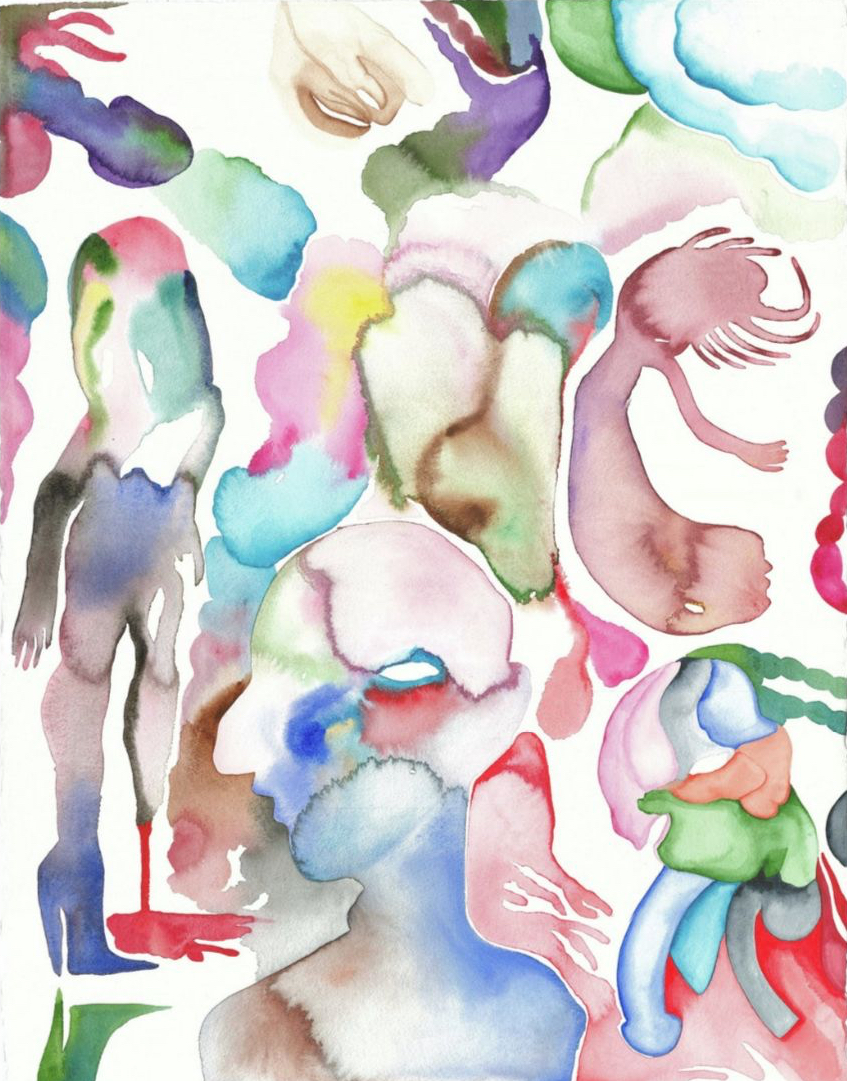
La Chola Poblete (b. 1989, Guaymallén, Mendoza, Argentina) paints large-scale watercolors, some over six feet tall, in which the Virgin Mary is fused with Pachamama, the Andean earth goddess: sacred, ceremonial figures rendered in a medium whose transparency and staining bleed give the images a fluid, unfixed quality that keeps received religious and racial iconography visibly in motion rather than settled into a single meaning.
Poblete studied art in Mendoza before moving to Buenos Aires, where an early period of poverty and rejection culminated in a formative crisis: encountering a reproduction of Velázquez's court dwarves, she felt that the European tradition she had trained in "didn't represent the real Argentina" or her own indigenous, Bolivian-descended family. Out of that crisis emerged La Chola, an alter ego who began as a performance persona and gradually became, in Poblete's own account, an inseparable part of her identity, one she continues to embody in performances with the drag collective Comparsa Drag.
In her watercolors, Poblete builds hybrid, syncretic figures, virgins crowned with Andean textile patterns, braids, and llama wool, their bodies adorned or interrupted by explicitly sexual and scatological details, that fuse devotional imagery with a queer, carnival excess closer to caricature than reverence. She has extended this material hybridity into sculpture, baking bread into small masks and figures that appear as reproductions within the watercolors themselves, and working with hair and iron to build installations carrying the same charge of transformation. Ejercicios del llanto (Exercises in Weeping), her 2022 exhibition at the Museo de Arte Moderno de Buenos Aires, brought this body of work its first major institutional recognition in Argentina.
In 2023, Poblete was named Deutsche Bank's "Artist of the Year," presenting Guaymallén, a solo exhibition named for her hometown, at the PalaisPopulaire in Berlin, and in 2024 her Vírgenes Chola series received a special mention at the Venice Biennale, part of the exhibition Foreigners Everywhere, making her the first trans Argentine artist recognized in the exhibition's main show. In 2026, the São Paulo Museum of Art mounted pop andino, curated by Adriano Pedrosa, bringing fourteen of the Venice watercolors together with new work. Across these venues, Poblete's project has remained consistent: not simply visibility for an underrepresented identity, but a reworking of who holds sacred and cultural authority in the first place. She lives and works in Buenos Aires.