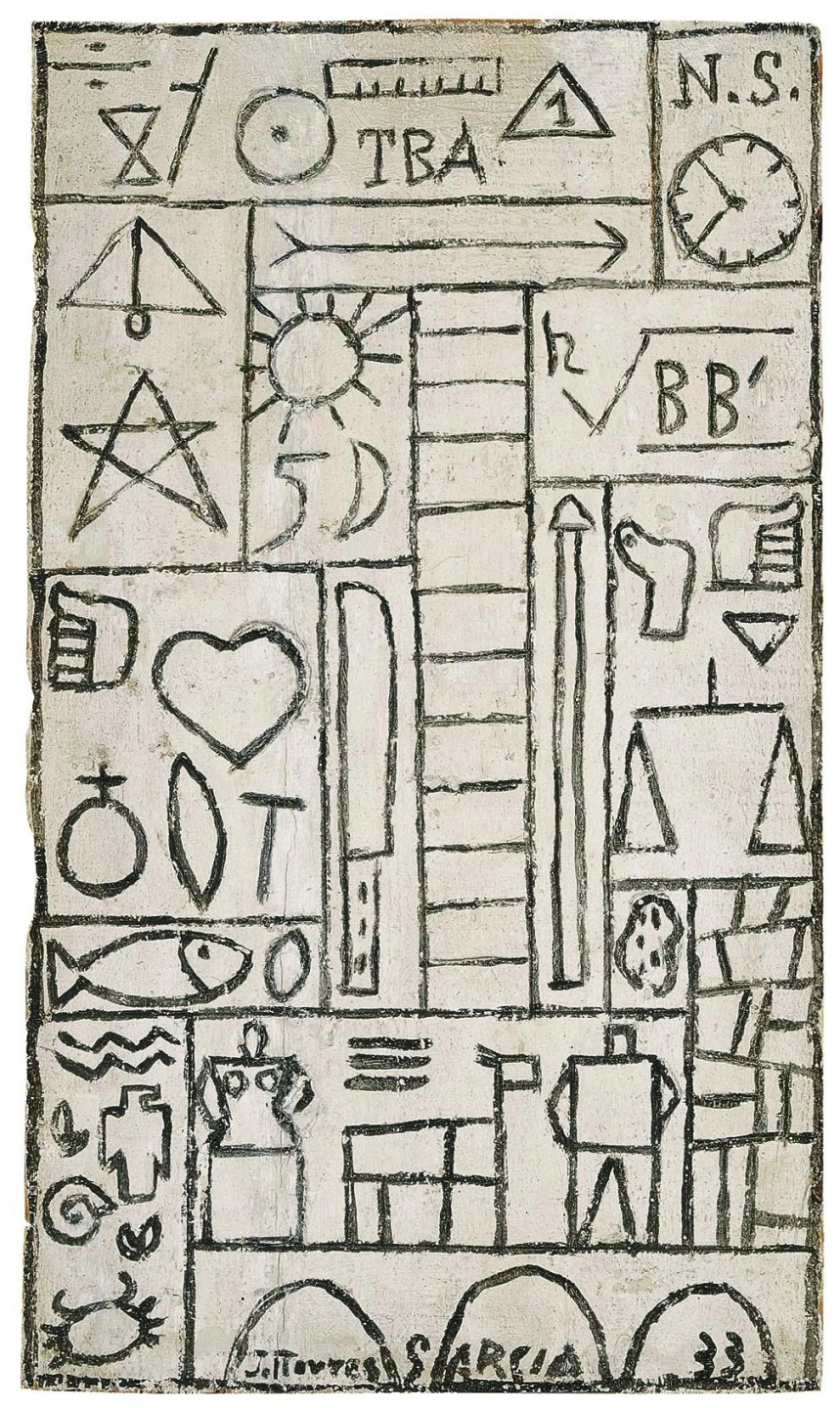
Joaquín Torres-García (Montevideo, Uruguay, 1874 – Montevideo, Uruguay, 1949) spent a lifetime working toward a single synthesis: a visual language fusing European geometric abstraction with the pictographic sign-systems of pre-Columbian American art, legible, he believed, across cultures and centuries alike. Contemporaries called him a "universal man" for the range of his gifts as painter, sculptor, muralist, and theorist, though the label undersells how deliberately unified his purpose actually was.
His family moved to Catalonia when he was a teenager, and he trained at Barcelona's School of Fine Arts, where he came to know Pablo Picasso; his skill as a draughtsman led to a professional collaboration with the architect Antoni Gaudí, for whom he designed stained glass windows for the Sagrada Família and Palma Cathedral between 1903 and 1907. After years split between Barcelona, New York, and Italy, Torres-García settled in Paris in 1924, where he absorbed Cubism, Dada, and Constructivism and in 1929 co-founded the group Cercle et Carré with the critic Michel Seuphor, uniting geometric abstractionists including Piet Mondrian and Jean Arp under one banner.
Torres-García returned to Montevideo in 1934, and it was there that he arrived at the mature synthesis he called Universal Constructivism: canvases and murals organized by a grid of rectangular compartments, each holding a single pictographic sign, a ship, a clock, a fish, a ladder, a sun, a human figure, an architectural fragment, so that ancient symbol and modern structure occupy the same picture plane as if they belonged to one continuous, timeless vocabulary. In 1943 he produced his celebrated inverted map of South America, a small drawing placing the continent's south where Europe's north conventionally sits, less a graphic joke than a direct argument that cultural and geographic authority need not run only from Europe outward.
That same year he founded the Taller Torres-García, a workshop-school known as the "Escuela del Sur," through which he transmitted Universal Constructivism as a teachable method rather than a personal style, training a generation of Uruguayan artists, among them Julio Alpuy, José Gurvich, and Gonzalo Fonseca, who carried the grid-based vocabulary forward long after his death. Torres-García's insistence that Latin American art was not a provincial echo of Europe but a center in its own right made him a pivotal figure in the region's modern art history.