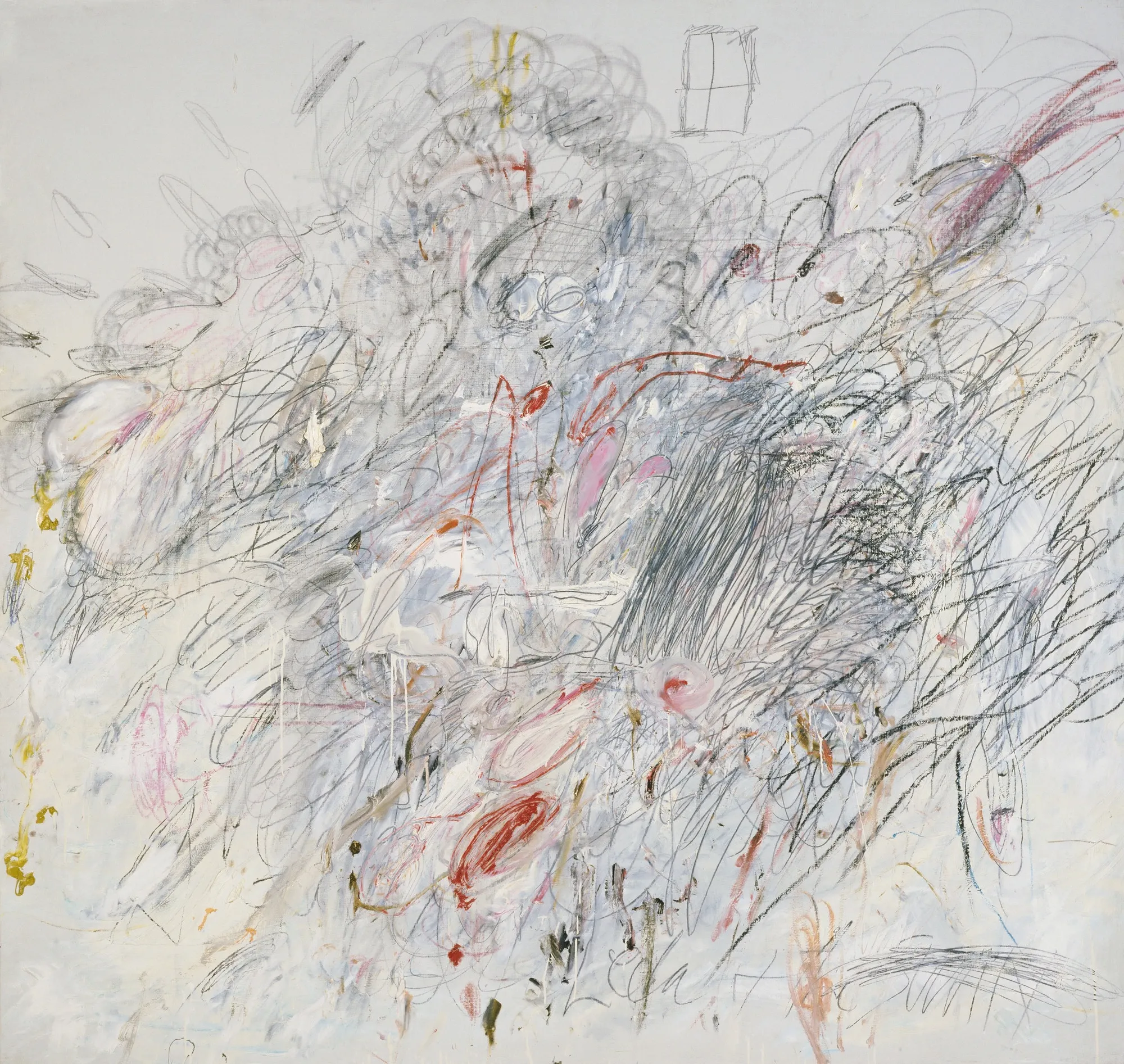
Cy Twombly (Lexington, Virginia, 1928 – Rome, Italy, 2011) married the gestural freedom of Abstract Expressionism to a private, sustained dialogue with classical antiquity, building paintings out of layered acts of writing and erasure rather than spontaneous doodling: words and fragments of text surface, are crossed out, half-legible, scribbled over, so that the surface reads like a palimpsest of thought caught mid-revision.
Twombly trained at the School of the Museum of Fine Arts in Boston and the Art Students League, where a fellow student, Robert Rauschenberg, urged him toward Black Mountain College. There he studied under Robert Motherwell and Franz Kline, absorbing Abstract Expressionism just as he began pushing past it toward calligraphic marks that read as much like ancient graffiti as painting, a vocabulary sharpened by a subsequent stint as an Army cryptographer, work that trained his eye on codes, ciphers, and the gap between mark and meaning.
In 1957, Twombly settled permanently in Rome, immersing himself in a Mediterranean world of classical ruins, myth, and poetry that supplied the underlying structure of his work for the rest of his career, even as its surfaces remained resolutely abstract, scribbles, drips, and fragments of scrawled text standing in for subjects as weighty as the Trojan War. Major cycles including Fifty Days at Iliam (1978) and the Lepanto series (2001) made this dialogue with antiquity explicit, while the vivid red loops of his later Bacchus paintings showed a continued evolution toward color and openness late in life. Twombly also worked extensively in sculpture, assembling found wood and plaster into rough, whitened forms that carry the same sense of accumulated, half-erased time as his paintings on canvas.
In 1995, the Menil Collection in Houston opened a dedicated Twombly Gallery, designed by Renzo Piano, a rare honor for a living artist, and a fitting testament to a body of work that transcended the usual categories of American postwar art.