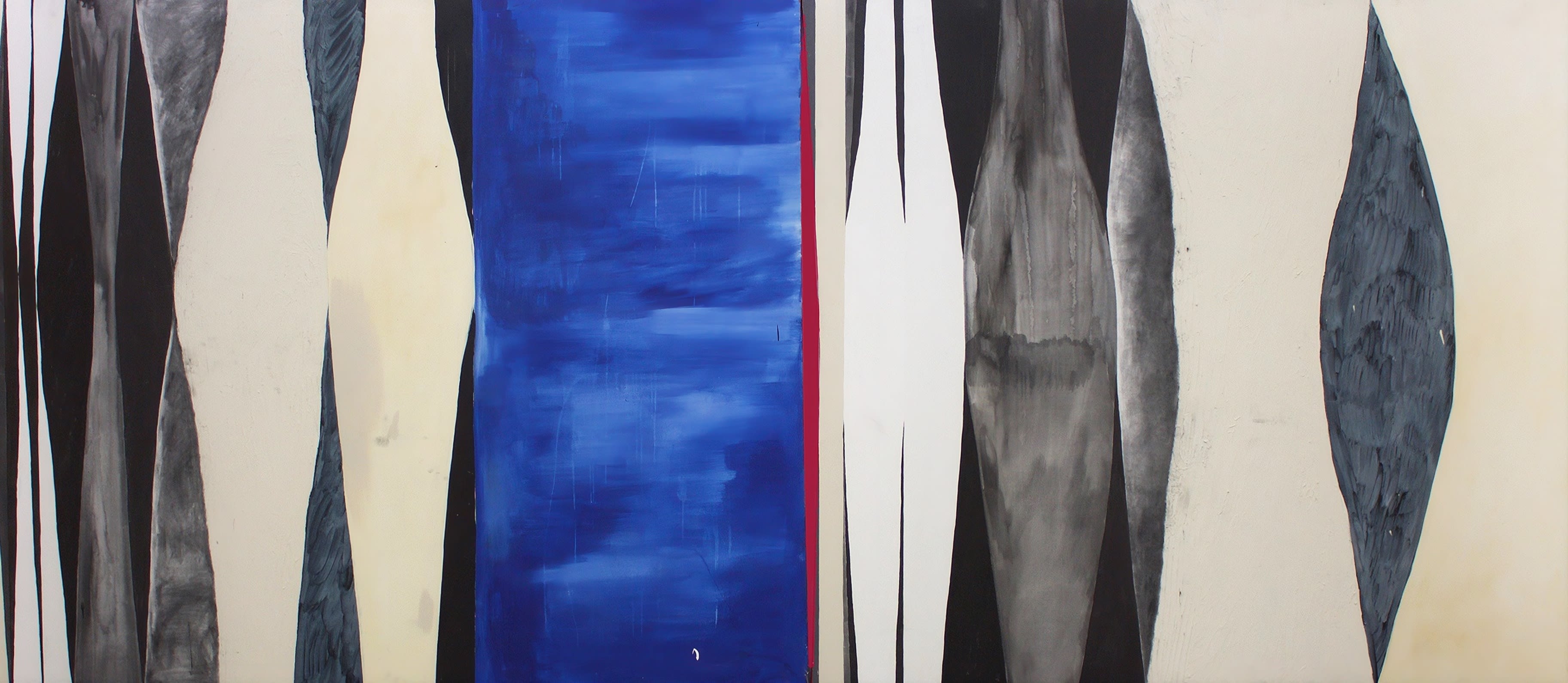
Assembly, Julia Rooney's debut solo exhibition, examines domestic space as it is both physically constructed and socially performed through the act of habitation. A room, the exhibition suggests, is never just built and then lived in. It gets remade, over and over, by the small routines and gestures of daily life: how people move through it, what they leave on a surface, which door gets used. Across a body of paintings and wall-based objects, Rooney treats the house less as a finished structure than as something still being negotiated between material fact and lived experience.
Central to this inquiry is how persistently Rooney collapses the distance between illusion and material reality. Rather than depict the substances of construction, she builds with them directly: Sheetrock, roofing felt, canvas, industrial sealants. A painting starts to behave like a wall. A wall starts to behave like a painting. The effect is to make viewers reconsider their relationship not only to the spaces they live in, but to the raw materials, and by extension the daily lives, that those spaces are assembled from.
This handling of found and industrial material puts Rooney's work in a longer line of artists who have turned to domestic and discarded materials as sculptural subject, from Dada assemblage through postwar figures like Robert Rauschenberg and Ree Morton. Her focus, though, stays close to home. Where those artists often worked outward, toward the street or the studio, Rooney's raw material is the house itself: its walls, its skins, its systems of repair. Through these unconventional materials and hybrid forms, she turns ordinary domestic objects into meditations on architecture, memory, and personal identity.
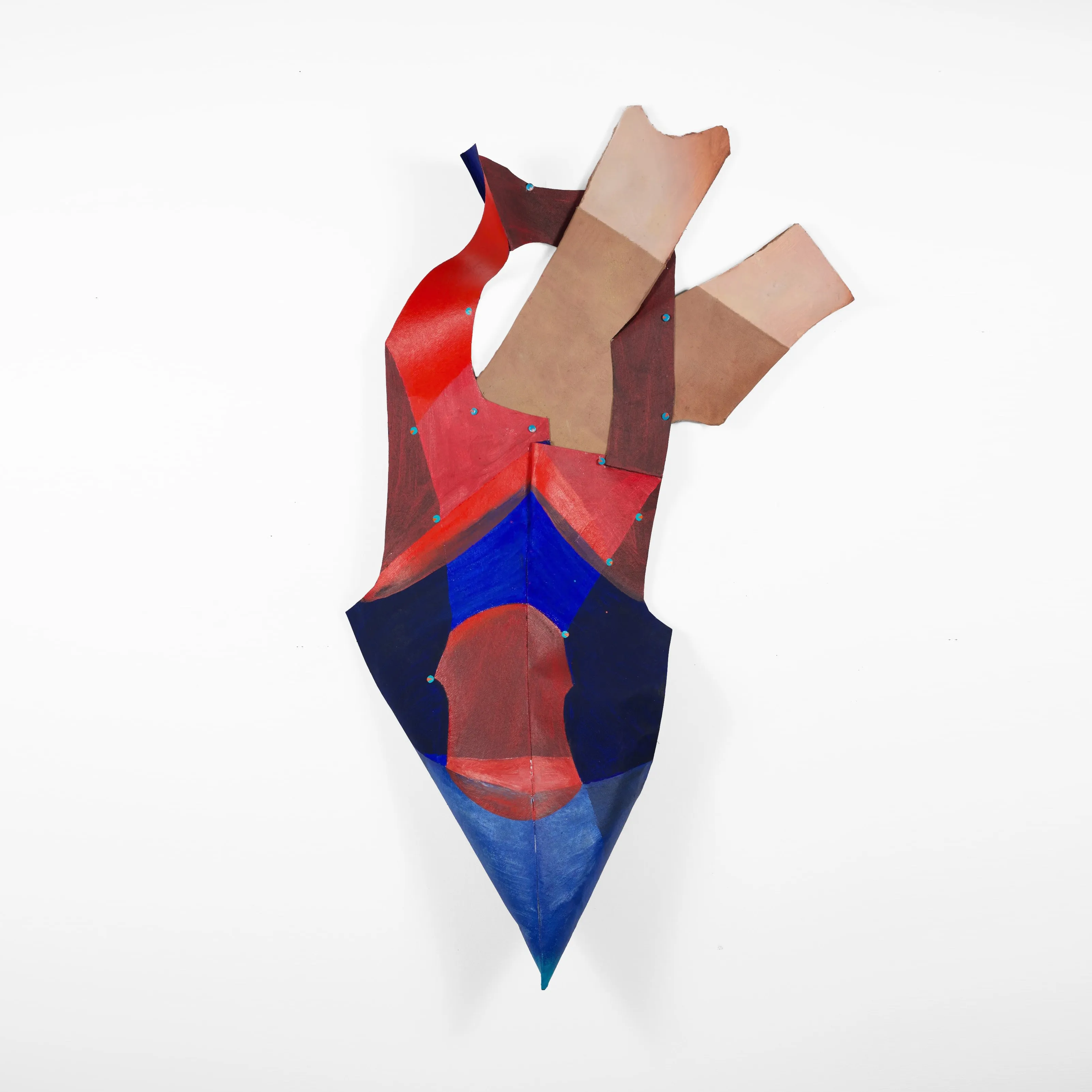
Among the works on view, Noseguard (2016) distills Rooney's experimental approach. Built from oil paint on Sheetrock, painted canvas, cut roofing felt, and roofing membrane, it holds fragility and resilience in the same object. Hand-stitching and reinforcements of Flex Seal and foam add both texture and structural support, so the handmade sits right up against the industrial. Its angular forms and saturated color read as fragmented and whole at once, drawing on the logic of domestic construction even as they work against its familiarity. In a sense, Noseguard is Assembly at a smaller scale: a study of how material, form, and function converge in the making and inhabiting of space.
About the Artist
Julia Rooney (b. 1989, New York) holds a BA in Visual and Environmental Studies from Harvard College and an MFA in Painting from the Yale School of Art (2018). In the years since Assembly, her practice has grown to include papermaking, cyanotype, and performance, though it's still rooted in painting's core concerns: surface, material, space. Solo and two-person exhibitions have followed at Kopeikin Gallery in Los Angeles, Arts+Leisure, Freight+Volume, and Below Grand in New York, Band of Vices in Los Angeles, and Essex Flowers in New York, several of them developed with her sister, the poet Anne Marie Rooney, as performative projects that use the U.S. Postal Service as both medium and collaborator. Fellowships and residencies have taken her to the Joan Mitchell Center, The Studios at MASS MoCA, the Vermont Studio Center, and Yale University Art Gallery, and in 2025 she presented new work at the NADA art fair alongside Tilt, a site-specific cyanotype installation at Yale Divinity School. Rooney is currently a teaching artist at the Museum of Modern Art and lives and works in New York.