Henri Matisse
Feuillage d'un arbre, 1941
Pen and India ink on paper
8 1/8 x 10 3/8 in (20.5 x 26.5 cm)


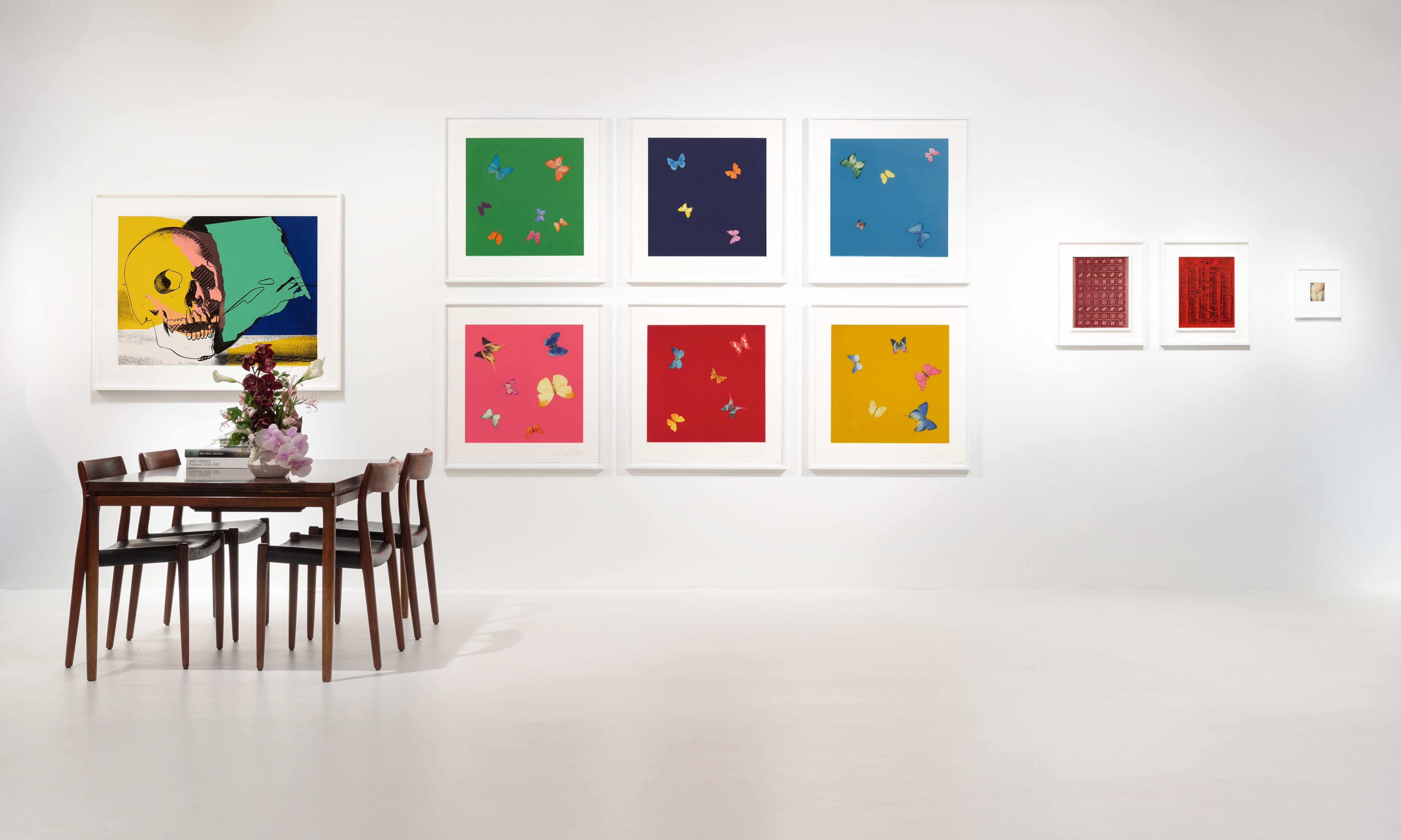
Installation views, Salon Art + Design 2024
In November 2024, at the Park Avenue Armory, Zeit Contemporary Art built its presentation for Salon Art + Design around four pairings spanning modern, postwar, and contemporary art: Andy Warhol with Damien Hirst, Julio González with Eduardo Chillida, Henri Matisse with Ellsworth Kelly, and Andy Warhol with Tom Wesselmann. The first half of the booth turned on mortality, material, and space; the second on color, nature, intimacy, and the body. These are artists rarely placed in conversation with one another, yet each pairing revealed a shared vocabulary for translating feeling into form.
Warhol and Hirst approached death through seductive surface and symbolic charge. In Love Poems, Hirst used butterflies as emblems of beauty, fragility, and impermanence. González and Chillida explored the expressive force of form and void in turn. González's late-1930s bronzes turned the hand into a sculptural sign of resistance, while Chillida's etchings translated a lifelong investigation of space into dense, architectural fields of black and white.
Matisse and Kelly shared a gift for distilling natural form into essential structure. Matisse's botanical and figural works on paper sat alongside Kelly's lithographs, where color and contour become their own experience of clarity. The closing pairing, Warhol and Wesselmann, took up the body through drawing and desire: Warhol's early works from the 1950s show an intimate, vulnerable side of the artist before his public persona took hold, while Wesselmann's studies for the Great American Nude and Sunset Nude series turn to sensuality and graphic compression. Taken as a whole, the four pairings sustained conversation between art and design, image and object, surface and feeling.
8 1/8 x 10 3/8 in (20.5 x 26.5 cm)
30 x 40 in (76.2 x 101.6 cm)
7 5/8 x 6 1/4 in (19.5 x 16 cm)
Receive occasional updates on exhibitions, newly available works, original research, publications, collecting insights, and gallery news from Zeit Contemporary Art.
We use necessary technologies to operate this site. Optional analytics and external media require your permission. Cookie Policy