
Julio González


Julio González
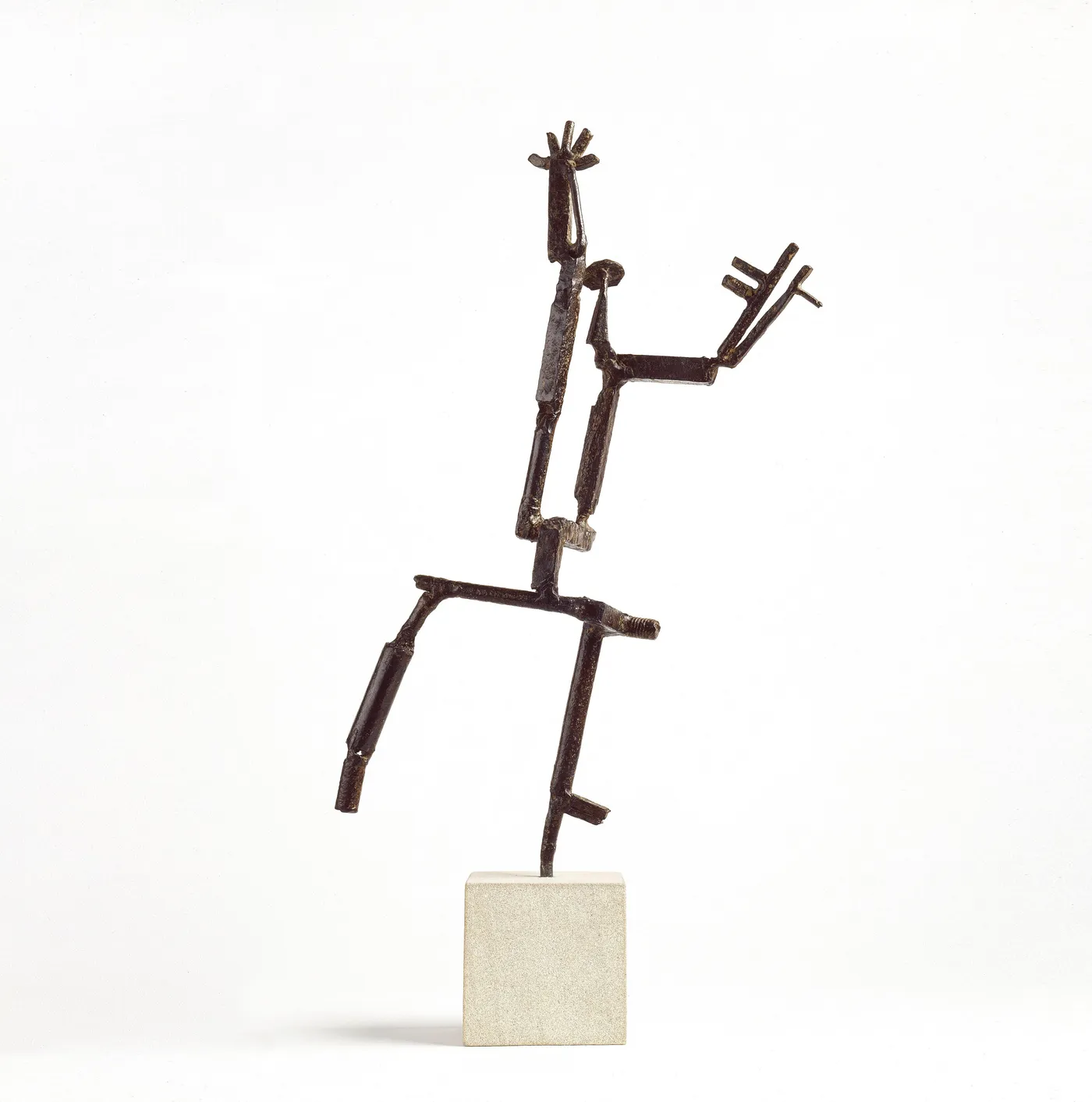
Julio González (Barcelona, Spain, 1876 – Arcueil, France, 1942) is remembered as the father of modern iron sculpture, the artist who first proved that welded metal, long confined to industry and craft, could carry the full weight of artistic expression.
Born into a family of metalsmiths, González learned to work metal in his father's Barcelona workshop while attending evening classes at the city's School of Fine Arts. He moved to Paris around 1900 with his family, where he renewed a friendship with a fellow Barcelona native, Pablo Picasso, and formed a close bond with the sculptor Pablo Gargallo, a relationship that would prove decisive to his own development. For years, though, González supported himself chiefly as a painter and jeweler; the death of his brother Joan in 1908 plunged him into a long depression, during which he largely abandoned art. During World War I, working at the Renault automobile factory, he learned the technique of oxyacetylene welding: a skill developed for wartime industry that he would spend the rest of his career repurposing for sculpture, drawn to iron, he later suggested, in part because he wanted to reclaim a material otherwise given over to munitions and machines.
González did not commit fully to sculpture until the late 1920s, working for a period as a studio assistant to Constantin Brancusi before a renewed closeness with Picasso proved decisive. When Picasso was commissioned to design a monument for the grave of the poet Guillaume Apollinaire, he turned to González for technical help; the two collaborated on welded metal constructions from 1928 to 1932, a partnership Picasso himself praised, marveling that González could work metal "like a lump of butter." The experience convinced González to leave painting behind entirely. His mature sculptures, reduced to rods, planes, and open volumes that he called "drawing in space," pushed the human figure toward pure abstraction, culminating in Montserrat (1936–37), a welded portrait of a Catalan peasant woman shown at the Spanish Pavilion of the 1937 Paris World's Fair, the same pavilion that housed Picasso's Guernica, as an emblem of Republican resistance. That same year, his work also appeared in the Museum of Modern Art's landmark exhibition Cubism and Abstract Art.
González died suddenly in 1942, leaving behind a body of work whose influence on later sculpture is difficult to overstate; David Smith, among the most important American sculptors of the twentieth century, called him simply "the father of all iron sculpture of this century."