
Sonia Delaunay

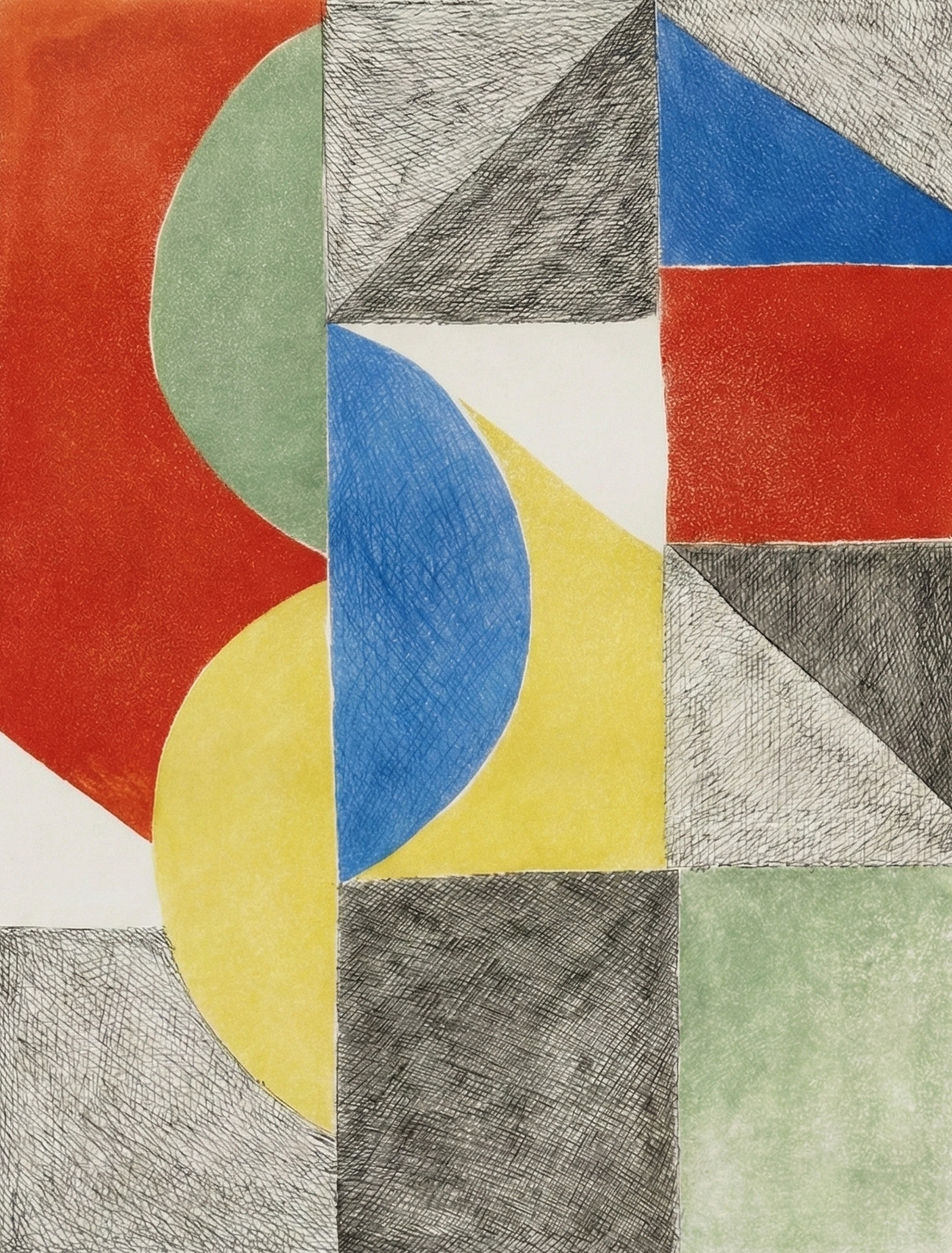
Sonia Delaunay (Odessa, Ukraine, 1885 – Paris, France, 1979) spent her career dissolving the boundary between painting and the rest of modern life, applying the same theory of color to canvas, clothing, textiles, and interiors until none of these registered as a lesser application of the other.
She trained at the Academy of Fine Arts in Karlsruhe before moving to Paris, where Fauvism and Cubism pushed her toward non-objective color. She married the painter Robert Delaunay in 1910, and the two developed Orphism together, though Sonia came to prefer the term "Simultaneous Contrasts," describing how identical colors and shapes shift according to what surrounds them. After making a quilt for their infant son Charles in 1911, patterned after Russian peasant blankets, she began applying the same pieced, patchwork logic to painting: Le Bal Bullier (1913) translates the movement and electric light of a Parisian dance hall into rhythmic arcs of contrasting color, a canvas she developed alongside the "simultaneous dress" she designed that same year for wear at the very dance hall it depicts, a piece the poet Guillaume Apollinaire called "a living painting."
Works
Projects
Stories
Essay · Thomas Clifton · September 12, 2025
Sonia Delaunay: Color Made Public
Color can give strangers something in common without requiring them to see alike. Sonia Delaunay’s prints suggest this possibility with particular force, offering images whose immediate appeal leaves room for different kinds of attention. Their openness is part of their public character: a composition can enter a shared visual world while retaining a distinct significance for each person who encounters it.
Read MoreSelected Press
Zeit Contemporary Art Showcases The History of Modern Prints
Annabel Keenan
Transformations in Printmaking Surveyed at Zeit Contemporary Art
Eli Anapur